Win on ChatGPT Ads
Early reflections on how OpenAI Ads work and the forces that will decide who wins
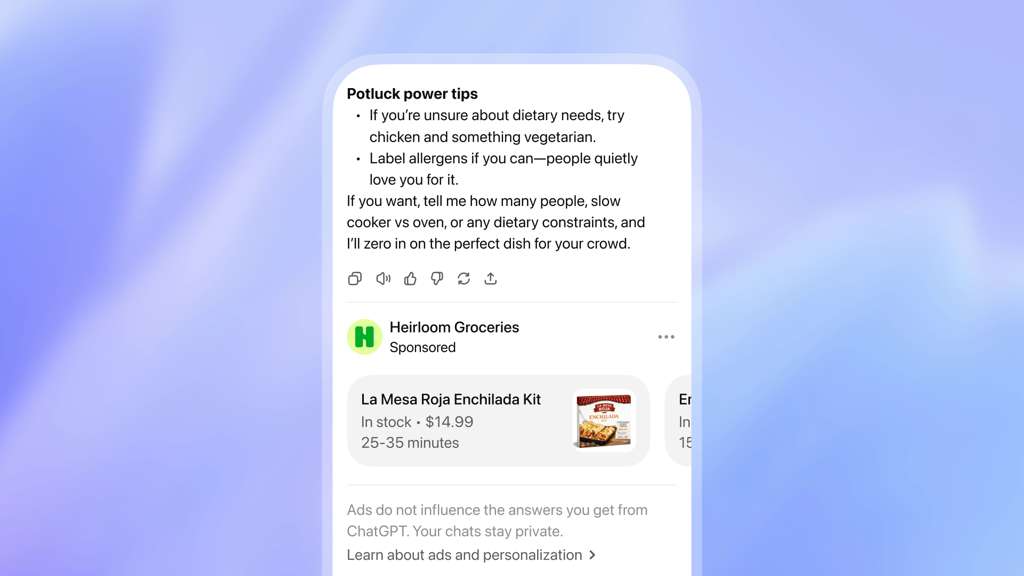
TLDR. OpenAI Ads looks like a shift in where performance moat lives. On Amazon, the edge is exact targeting and bid optimization. On ChatGPT, the edge moves to context hints and speed of iteration. The good news is that our measurement system at Laurence transfers directly from Amazon Ads. The hard part is learning how to improve context hints, creative, and landing pages as one system.
The shift I see
On Amazon, you can bid on specific keywords and control bids at that keyword level.
On ChatGPT Ads, you cannot control it that way. You set a max CPC, and you write context hints. So the game changes. You are no longer just managing bids. You are trying to communicate the right way to an LLM so your product gets entered into the right auctions.
This is a much bigger shift than most people think. Performance marketing is moving from button clicking to model communication. The teams that do best will be the ones that learn how these systems read intent and how to steer that intent with better inputs.
What transfers from Amazon and what does not
A lot transfers.
The feedback loop is still the same. We still watch impressions, clicks, spend, CPC, CTR, conversions, sales, and ROAS. We still run tests, compare results, and iterate fast.
What does not transfer one to one is the targeting mechanic. On Amazon, we can harvest search terms and push winners into exact campaigns. On ChatGPT, we need to engineer context hints that pull us into the right auction pool.
My simple hypothesis for how the backend works
I think it works roughly like this.
A user writes a prompt. OpenAI interprets that prompt and creates a set of products that look relevant. Only those products become eligible for that auction. Then the platform chooses who gets shown based on factors like relevance and max CPC.
I also think the system will keep learning over time. If an ad gets clicked and converts well for certain prompt patterns, it is more likely to be eligible again in similar auctions. If it gets clicks but weak conversion, it should lose quality over time.
If this is directionally right, then our job is clear. We need to reverse engineer this system through disciplined experiments on context hints.
Why secondary inputs still matter
Context hints are the main lever. Max CPC decides which of those auctions you can actually win.
But title, description, image, and landing page still matter a lot. They are multipliers on auction quality. If these are strong, good auctions perform much better. If they are weak, even good auction entry will not save the account.
This is also why we need to think beyond ads only. If we want to take over more of the marketing stack at Laurence, we must improve these pieces too. For some landing pages, no context hint will ever be good enough to drive strong conversion, profitability, and brand growth.
The playbook I want to test
The right way to run this, in my view, is to start with very specific context hints that only target a small type of auction and a clear audience.
Then we measure performance in that narrow setup.
If it performs well, we graduate that hint into a main context hint prompt that combines all winning auction types. If it performs badly, we drop it and keep testing.
So the new exact match equivalent is not one keyword. It is a tested context hint pattern that consistently gets us into auctions where we convert well.
I also want to test a negative targeting style in context hints, where we explicitly signal contexts we do not want so OpenAI is less likely to enter us into auctions that historically convert poorly for us.
This is still early for me, but I feel confident about the direction. The winners in ChatGPT Ads will be teams that learn context hint engineering faster than everyone else.