Explore fast, exploit when direction is found
Startups win by building tight feedback loops that reveal direction early, then scaling what actually works.
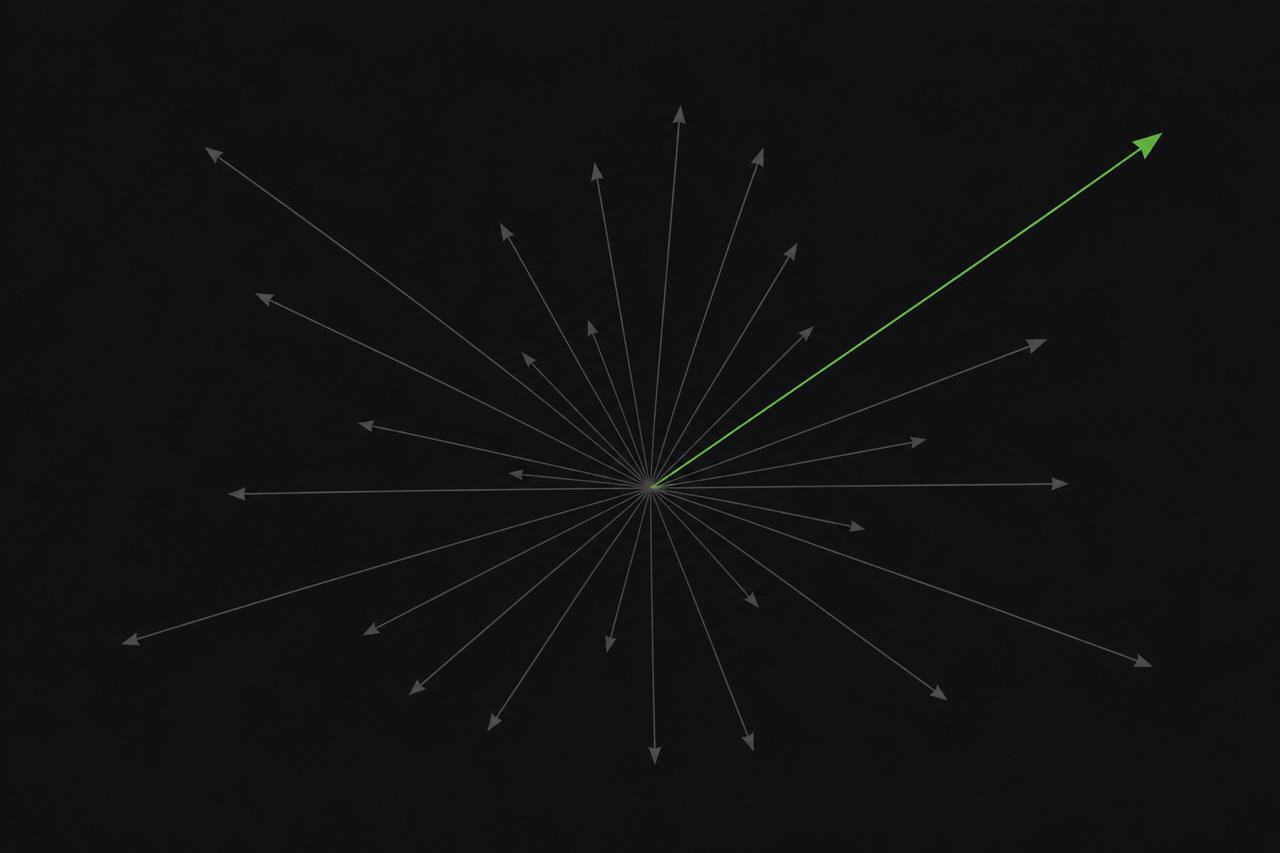
TLDR. Startup execution is mostly a direction-finding problem. You move fast, but only if your feedback loop is good enough to tell you whether you are moving toward or away from the right direction.
Most teams say they move fast, but what they often mean is that they ship a lot. That is not the same as learning fast. If each cycle does not improve your understanding of what works, you are just burning energy at a higher rate.
The most useful thing I learned in consulting was that good problem-solving needs a current hypothesis at all times, even when you know it is imperfect. Without that, iteration becomes noisy because every action is disconnected from a clear directional bet.
The vector metaphor is still the cleanest way I think about this. Early in a problem, the vector is unstable and low-confidence, so direction shifts often as new evidence comes in. That is healthy. You are exploring. But as signals become cleaner and repeatable, the direction stabilizes, and then the game changes from searching to compounding.
At Laurence, this is exactly how we operate. We test a bidding method, compare pre-change and post-change performance, and read the signal through sales, spend, profit, and efficiency. If the direction is clearly better, we scale it. If it weakens, we adjust and rerun. The edge is not any single experiment. The edge is the quality of the loop.
We also document decisions and outcomes in our knowledge flywheel, so every new cycle starts from accumulated context instead of memory fragments.
The part I want to explore next is agents. My current view is simple: agents are multipliers of system quality. With strong context and tight feedback loops, they accelerate good direction. Without them, they accelerate drift.